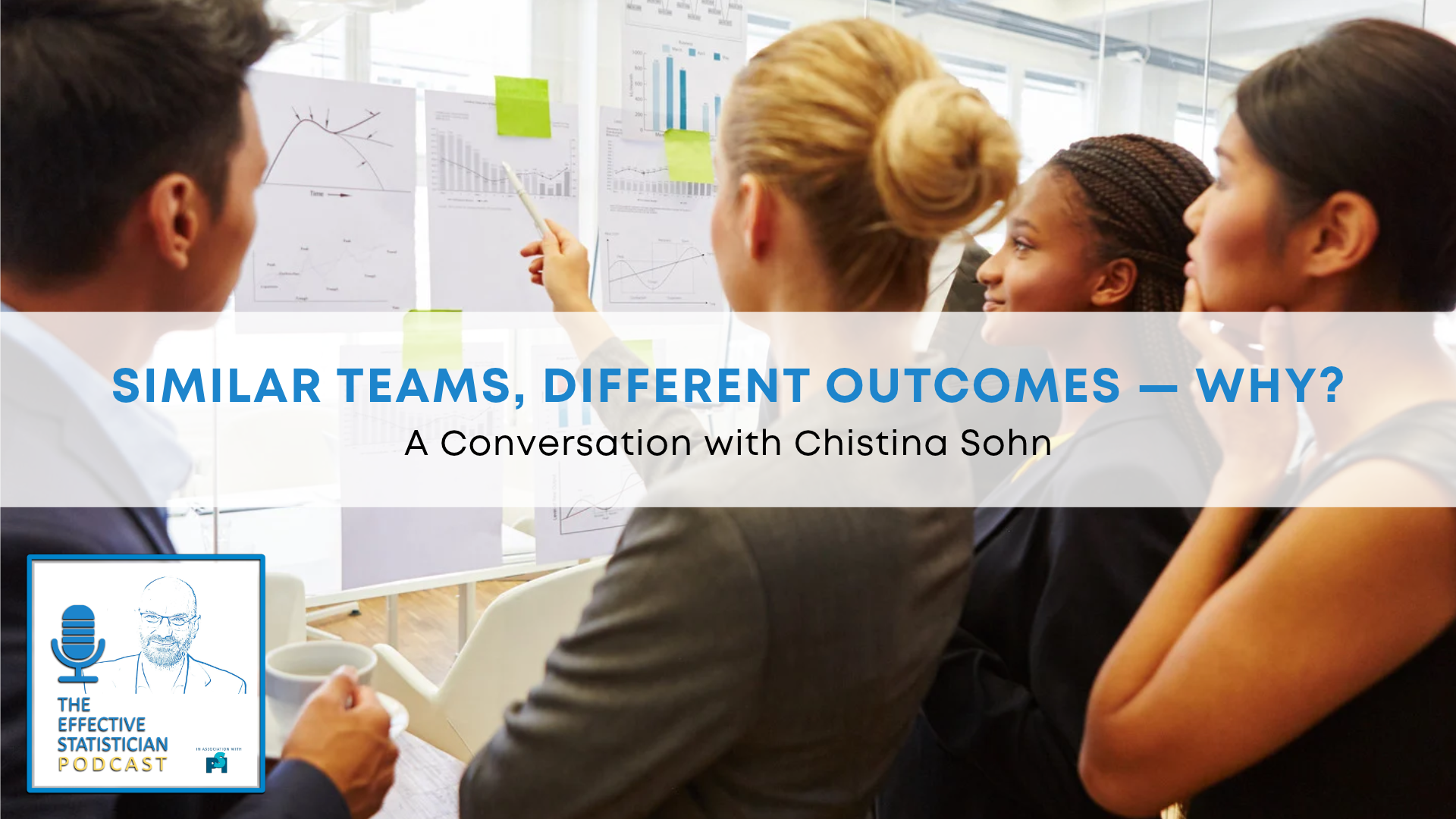

Why do teams with similar expertise achieve very different results?
I talk with coach and trainer Christina Sohn about how trust, shared goals, and constructive conflict shape team performance. We explore practical ways to speak up, handle disagreements, and strengthen collaboration in virtual teams.
Why you should listen
Have you left a meeting thinking everyone agreed, only to discover competing plans afterwards? Or held back an idea because you worried about your colleagues’ reactions?
Christina and I discuss how you can:
- Clarify what success means across different functions.
- Recognize warning signs of low trust.
- Raise concerns and share ideas through thoughtful questions.
- Turn disagreements into better decisions.
- Build stronger relationships with colleagues in virtual teams.
Episode highlights with timestamps
- 02:47 — Define what your team wants to achieve
- 04:13 — Clarify what a successful study means
- 06:07 — Pay attention to how you achieve results
- 08:24 — Spot the warning signs of low trust
- 12:29 — Turn different opinions into better solutions
- 13:47 — Speak up when you fear rejection
- 17:18 — Disagree while respecting your colleagues
- 19:16 — Pause and address disrespectful communication
- 21:27 — Strengthen connections in virtual teams
- 25:56 — Support each other and win together
Links and Resources:
🔗 Connect with Christina Sohn on LinkedIn
🔗 Learn more about PSI and become a member
🔗 The Effective Statistician Academy – I offer free and premium resources to help you become a more effective statistician.
🔗 My New Book: How to Be an Effective Statistician – Volume 1 – It’s packed with insights to help statisticians, data scientists, and quantitative professionals excel as leaders, collaborators, and change-makers in healthcare and medicine.
Join the Conversation:
Did you find this episode helpful? Share it with your colleagues and let me know your thoughts! Connect with me on LinkedIn and be part of the discussion.
Subscribe & Stay Updated:
Never miss an episode! Subscribe to The Effective Statistician on your favorite podcast platform and continue growing your influence as a statistician.


Never miss an episode!
Join thousends of your peers and subscribe to get our latest updates by email!
Get the


Learn on demand
Click on the button to see our Teachble Inc. cources.
Featured courses
Click on the button to see our Teachble Inc. cources.
Christina Sohn
Business Consultant | Leadership, Collaboration & Organizational Development | Founder of ACS 3 Steps
Christina is a business consultant, coach, and trainer who supports leaders, teams, and organizations through her company, ACS 3 Steps. She combines experience in controlling, finance business partnering, and marketing analytics with a focus on leadership, collaboration, and organizational development. Her approach explores how people, team dynamics, structures, and processes interact to shape performance and lasting change.
Transcript
00:00
You are listening to the Effective Statistician Podcast. The weekly podcast with Alexander Schacht and Benjamin Piske designed to help you reach your potential, great science and serve patients while having a great work-life balance.
00:21
In addition to our premium courses on the Effective Statistician Academy, we also have lots of free resources for you across all different topics within that Academy. Head over to theeffectivestatistician.com and find the Academy and much more for you to become an effective statistician.
00:49
I’m producing this podcast in association with PSI, a community dedicated to leading and promoting user statistics within the healthcare industry with the benefit of patients. Join PSI today to further develop your statistical capabilities with access to the ever-growing video-on-demand content library, free registration to all PSI webinars, much, more. Head over to the PSI website at PSIweb.org.
01:17
to learn more about PSI activities with the Kammer-PSI member today.
01:28
Welcome to another recipe series of the statistician. Today I have Christina Sohn with me and we will talk a bit about Teams. And because she wrote about this on LinkedIn and I thought this is really, really insightful. And because you can have very similar teams from a team setup. Lots of our typical project teams have the same setup. They can have very, very different outcomes and actually working within them.
01:58
can feel very, very different. And so we’ll dive a little bit into that today. But before we do, Christina, maybe you can introduce yourself and what you’re doing. Yeah. Thanks a lot, Alexander, for the invitation. And let me introduce myself. Today I’m a coach or a trainer and I’m working with leaders and teams. And we’re looking at effective collaboration.
02:21
From my background, I’m 20 some more years in business and mainly concentrating in that case on finance and controlling, but also adding to marketing analysts and there I had different roles and different perspectives. My lens today is more on a business performance factor, which is also including the human dynamics, which are mentioned by your introduction.
02:47
what is influencing each other and how it is working together. let’s say I always look at both business performance and the human dynamics that shapes the whole thing. podcast is called the effective statistician and that’s for a reason. Now, when is a team affected? What does that mean? Well, first of all, let’s focus on the actual shared goal.
03:15
which is the goal and what is the task or topics we are concentrating on and what results would we like to achieve with what we are doing and where does the energy of the work is going or heading to. So if we are having a conflict, it’s not always bad. Conflict is a good thing if we are looking at different opinions or different perspectives. Even so, we can generate better solutions through a conflict.
03:44
So we have to see where we are getting the focus on. So if it’s shifts from topic to person or from solution to being right, from the expertise to superiority, or if we are having shared goals or it’s just about winning, then we need to see what is going on in the team. therefore two things are most important. So where’s the focus on? The other thing is
04:13
Are we still concentrating on the issue we want to solve or is the result of what we want to achieve together important? Yeah, I think that is a very, very good first question usually. What do we actually want to achieve? And many people would say in our context, well, we want to run a successful study or we want to design a successful study. But that is a very vague thing. What does successful mean?
04:41
If you talk to different people, it can mean very, very different things. can talk to, if you talk to someone from operations, maybe it is on time and on budget. And maybe if you talk from someone from a medical perspective, it is, we have a positive outcome at the end. Or if you think from a regulatory point of view, well, we can move forward and get approval for the next step.
05:10
Or maybe there’s a statistician, things like, I have implemented a really fancy design that I can then publish about and have a paper and presentations. Well, that can actually be from any other person as well. So there are all these individual goals that may come from their functions or them personally. And my perception very often, it’s not really clear what does that mean being effective.
05:38
Also in terms of thinking like having a balance between what you achieve and what you put into it. Yeah, you can achieve quite a lot when you have a lot of resources, but how about achieving something that is pretty good with minimal resources? And then the other thing that I’m thinking about is, and that’s something that I learned once early in my career. Sometimes it’s not just about what we achieve.
06:07
at how we achieve it. As I was in a team and we created a great outcome, but afterwards, nobody in the team wanted to talk to each other anymore. That’s success. Yeah. If you burn all the bridges along the way, probably not. So what’s your experience in terms of actually how to get to a common understanding of what our goal is or what does effective actually means? So, well, I think there’s…
06:36
Several things, which you also mentioned in your speech right now is one thing is it’s important, always important to define what is meant with the goal. So a goal, you said, can be from a different perspective, slightly different from one point. So if we have governance and governance is giving a direction. And then we have the outcome of the budget.
07:02
how this is running, for example, and how good this is running. It’s a different perspective, but both have a target and they need to define if they’re working together, what they are heading up for. So this is an important part, but nevertheless, so focus time as an important thing. When we are concentrating on working as a project team member, we are not working only for the time being of the project, but also
07:29
It’s important to be sure that we are discussing things afterwards and there’s a relationship buildup that is working afterwards, which you also mentioned. Then we are having ideas and innovations and this is something you can bring up if you are having trust in a team and everyone is focusing on the same target. And then from the organizational point to get.
07:55
better decisions that you are just counting on the actual topic things and are going into that. Also quality is a point where you need to do to be aligned with to see what is going on. Yeah. So basically when we think about the goal, we need to go through all these different aspects and maybe there are trade-offs that we want to make. Maybe speed is more important than cost and
08:24
When we think about quality, what does it exactly mean? Because that is also very, very often a generic term and people understand very different things around it. Having a discussion about this is really important. And here very often, as you said, conflict arises. One person wants something different than the other. And you mentioned trust in that perspective. How do I recognize if there is a lack of trust in the team?
08:53
I think from my perspective, probably I can very easily recognize who I trust in the team and who I don’t trust. That even if I think like I trust here everybody, how do I see that there’s not really a good overall trust in the system? Well, I think there’s not that one answer to it. Being reliable is an important thing that people are sticking to what they said or what they intend with their perspective.
09:21
And that they are sticking to certain rules, which the team needs to define. Because if you are in team and you don’t have any rules or any directions you are following, then it will be difficult because there’s interpretation on everything. As we just had in our discussion, there are a lot of words which are broad and not really focused on what is meant with, for example, quality.
09:50
So it’s really important to find definitions and to follow certain rules that are defined by the team so that the team knows what they are talking about. And if this is, say the baseline, then trust can be built up from my perspective. Rules, also mean having rules of how you talk to each other, how you behave, things like that? I think this is also important. Yes.
10:16
Some things are also defined by the culture they are having in that group. A group is always building a subculture for always communicated what is communicated. And in that case, it’s sometimes helpful if they are defining what is okay or what is not okay. If they are starting up from scratch. Yeah, I think that’s a good point. What is commitments from the team to listen to each other, to not speak of each other.
10:46
And that especially can be a big cultural thing. I know that there are certain cultures, but it’s completely normal to talk over each other and other cultures, there’s an absolute no-go. And having that, or also what you said about commitments. One sign of no trust is if commitments are not hold. That when people second-guess things. If you have a meeting.
11:13
And 10 minutes after the meeting comes an email that says something completely different to what you have just discussed. Or these, you come out of a meeting and then you see two persons in the hallway talking about things that they should be done differently than just discussed in the meeting. So when you see that people, team members withhold information or are afraid to speak up.
11:37
That is definitely a pretty red flag because it shows people are afraid to have a conflict. And if people are afraid to have a conflict or fear of conflict, then there’s really a lack of trust, my perception. For sure. And the importance there is also that we are losing a lot of energy on human dynamics, which can be
12:01
where energy cannot be focused on the actual topic and is moving the focus on different things. So concentration is lost, quality, ideas, decision are all influenced by those things. And business performance in the end is suffering from those situations. And as said, energy we lose in unnecessary friction is not something which is available for the actual work. We talk about now, what does
12:29
conflict mean to you? Because I know conflict can have very different connotations to people. So when we talk about conflict, what does it mean to you? But actually there is a conflict which is driven by the actual subject we are facing. Then it’s really a fruitful thing because then you have different perspectives.
12:53
You have different opinions and while people are discussing on the topics, they are getting closer to each other. So trust is built. Conflicts in that case are just building up a community where things are shared, where they can move up to the next level. say like that. The conflict for me is really just like you said, different opinions on a topic.
13:17
It’s not necessarily mean you’re yelling at each other or even worse, throwing things at each other. It’s really just having different opinions. Like, do you want to have a two arm design or a three arm design? Do you want to have these types of patient reported outcomes or a different one? Do you have an enriched population or the more focused population or the broader population? There’s so many different design options that you can have in a study design.
13:47
And also then later in terms of results, interpretation of results, communication of results, there’s hundreds of different areas of conflict. And the important thing is to have the conflict. If I’m afraid of conflict, what can I do to engage conflict better? Well, it’s again, something which is focusing on trust. If I am from my perspective.
14:14
not trusting the person on the opposite side to understand that we are looking at a subject and not an emotional part, then I need to find out what is actually behind that scene that is forcing me to step back. And then it’s important to say, okay, from another perspective, if I’m starting with myself, my role, what is my role? What is my responsibility? And what is the part?
14:43
which belongs to others. And maybe it’s something in my behavior that is changing the opposite position of getting emotional or being at the subject. So there’s a lot also about looking at oneself. What can I do or what can I change and what am I bringing in? This is influencing our relationship or connection. Completely agree. I’m fearful of speaking up.
15:10
It’s very important to understand where that fear is coming from. And in my experience, the fear is often coming from a fear of being rejected. And so being rejected in terms of someone says, that’s a stupid idea. Or someone says, we talked about a lot already about this. How do you don’t know about this? Or something that basically pulls you down.
15:40
And so it is from my point of view, very, very important here to understand where your strengths are and how your strengths are different to all the others. And as a team member, you’re usually in this team because you have a specific skill set that nobody else does. A specific experience that nobody else does. And sometimes maybe it’s just the lack of experience.
16:08
So maybe you can just bring this curiosity into the team where you challenge the status quo or challenge we have always done it that way things. And if you don’t want to be very firm in your opinion, you can always put it into a question. You can always ask like, what about if we do exactly
16:32
Or what are the difference between what we are doing now and this alternative way of doing it. And so inviting others to share their view. Because I think this is where a conflict resolution is at its best if everybody is curious about what the others want. Instead of, as you said earlier, winning. Yeah, I’m right. And I, I’m therefore want to win the argument.
17:00
And you are wrong, therefore you will lose the argument. And if you get into that situation, that’s really, really difficult because then it’s not about finding an optimal solution. It’s about winning. Yeah, I fully agree. It’s also getting into a discussion.
17:18
What you mentioned is the possibility to into a discussion from having conflict to get into a discussion where fruitful information is given and shared by the team. So questions are lot bringing up, are helpful to one another to understand what is going on and to find in the end a better solution and also from a team perspective to see that everybody’s seen.
17:48
And most of the times people, or let’s say other ways, it could be that people are doing things like that, saying, how can you not know about that or something like that that is because they are themselves are missing something. And so maybe it’s the point of being seen as the one with the skills, the one who is also having a broad perspective on certain topics.
18:17
So there’s also something where you can give or you can support people by saying, wow, this is a really good idea of what you are saying. I could add something where I see also something which is helping your perspective or is supporting your perspective is more likely to say. By the way, I like this. can add to that. It’s a very, very good approach to even disagree.
18:46
You don’t say, no, this is a really stupid idea. You can say, yes, I’m really interested to learn more about this. I think there’s another aspect that we also need to look into that is XYZ. And that is a polite way to say, yes, I can see where you’re coming from, but I think you missed that part without blaming the other person. By the way, if someone says these nasty things in a meeting, that’s probably time.
19:16
to have a stop on talking about the design or the study or the project whatsoever, but to talk about how do you communicate within your team. So basically call the time out and say, Hey, I think we need to look back into the rules that we have set for ourselves, which you mentioned earlier. That’s really important. It’s so easy to get over this initial let’s talk about things and set up rules stuff. If everything works fine, okay.
19:45
But if something doesn’t work fine and sooner or later someone will have a bad day, especially in these teams that work together over years. And then it’s good to get back to the roots. Yeah, for sure. And this situation you mentioned before.
20:03
is always an important point to really cut and make a cut and say, okay, we need to discuss now or something else because this is more important than any other topic, any other goal to achieve. Because if this is not clear, then everyone is losing in the end. Basically, if the whole team dynamic breaks down and says no psychological safety anymore, it doesn’t actually make sense to talk about any content topics.
20:31
You first need to get back and sort out your team dynamics. Definitely. And that’s so important to concentrate on such things. Even so there, some say, might say it’s easy or everything is clear. No, it’s always important as the muscle, as I compare it sometimes with training a muscle because it’s something you need to train day over day. And to get back to the rules is also training because otherwise time flies by and things.
21:00
And memories are not keeping up everything of the rules. So an important thing is also to always train what are the rules we defined. Is this still something we’re sticking to or do we need to adjust? Because then we can be sure that people keep in mind what is important for the team and for the goal they are trying to achieve. One of the big challenges I see is
21:27
that Teams now operates very differently from where I started. Well, I’m already a little bit older, so my first Teams were over 20 years ago and pretty much everybody was sitting in the same location and we were seeing each other on a daily basis. And nowadays, very often Teams are completely virtual. Yeah, so there is someone in the US, someone in Spain, someone in Germany, someone…
21:54
Britain and she also has someone in Japan, then it gets completely weird, but because of time zones, not because of cultures. So what can we do to have more coherent, more effective teams if we have this virtual setup? Actually, from my experience, are different ways people are making meetings every Friday or every Wednesday to say, okay, we’re just sitting there.
22:22
in front of the camera and having the camera on and they’re talking to each other just about private things, about things they experienced during the day or during the week. So it’s not always just having a discussion on business, but it’s also important to see the person behind. And therefore also private conversations need to be part of virtual conversation. Even so there’s a lot of
22:48
pressure. And I know for sure there are things where you have timelines and this is not fitting to your schedule at the moment. But nevertheless, if we are losing that part, the personal part, not private, direct private part, but things from a personal life, then an important bridge is broken down. completely agree. You need to see the person behind things.
23:14
On the other hand, it’s not just a physician, a project manager, a regulator. There’s also a mother, a father, a friend, someone that struggles with a divorce, someone that is worried about their elderly parents, someone that is looking forward for vacation, someone that is really, really excited about the next upcoming football match or something like this. And all these connections really matter to see not
23:44
just the business person. And I think this is really important to build trust and also to really want the other person to succeed as well. In the past, I would have always recommended have some, have a dinner together. And I still recommend that and take the opportunities that you can have. Maybe you all get to the same conference. Maybe there’s a business trip and you go into the same city where your counterpart lives. Get together.
24:12
At least have a beer or wine or a glass of water together, coffee, anything. It helps so much. The other that I recommend is having one-to-ones in addition to the just the team meetings. Because the team meetings can be sometimes quite large. What do you think about these one-to-one approaches?
24:34
This is also important from my experience, I always think, as you said, it’s really important to get the person, to get a full picture of the person, not the businessman or a woman, but also the private person behind. Because then, as you said, this is the baseline for trust. If we are knowing how this person, or if we are knowing more about that person, then we are able to understand more.
25:00
how might be some reaction in the future that was not foreseen or not understandable if he wouldn’t know personal information or wouldn’t know a personal situation. For example, if there is someone suffering from a disease and is still working, this person has a focus on two things. And if there is something going wrong, it might be that you say, okay, he’s just lazy or she’s just lazy.
25:26
But it also could be that there is a disease behind or as you said, elderly people, parents, kids, wife, divorce or whatever. So this is also influencing our business focus. And if we’re not knowing anything about that person, we cannot understand and maybe also support them because it’s not always about just having a goal, but also having a powerful team and a powerful team can only be there if people are supporting each other.
25:56
That is a very good last sentence. A team is only there if everybody supports each other and you win as a team and you lose as a team. And it’s clear what winning looks like. And that winning is not just about the end result, it’s also how you get there. We talked quite a lot about building trust and resolving conflict are very, very important aspects of it.
26:24
And we talked about how you can speak up when you’re afraid to speak up. there’s especially maybe early in the team building effort, you don’t have that big trust, but you still need to raise your opinion. The last thing, Christina, if anybody wants to work together with you, where is it easiest to find you? First of all, you’ll find me on LinkedIn, but I also have a website or yeah, telephone.
26:53
I put all of that into the show notes. And so if you want to talk more with Christina about team building, but also all the other aspects that you mentioned, think it’s pretty interesting to have also this finance controlling background because in the end that plays a major role in all our companies. And I for myself have very, very little experience in this. Even though I studied a little bit of economics, but yeah.
27:22
That’s still a big thing. Thanks so much for listening and Christina, thanks so much for being on the show. Thank you very much for the invitation and the wonderful discussion we have.
27:39
This show was created in association with PSI. Thanks to Reine, who helped with the show in the background, and thank you for listening. Reach your potential, leave great signs and serve the patients. Just be an effective statistician.
Join The Effective Statistician LinkedIn group
This group was set up to help each other to become more effective statisticians. We’ll run challenges in this group, e.g. around writing abstracts for conferences or other projects. I’ll also post into this group further content.
I want to help the community of statisticians, data scientists, programmers and other quantitative scientists to be more influential, innovative, and effective. I believe that as a community we can help our research, our regulatory and payer systems, and ultimately physicians and patients take better decisions based on better evidence.
I work to achieve a future in which everyone can access the right evidence in the right format at the right time to make sound decisions.
When my kids are sick, I want to have good evidence to discuss with the physician about the different therapy choices.
When my mother is sick, I want her to understand the evidence and being able to understand it.
When I get sick, I want to find evidence that I can trust and that helps me to have meaningful discussions with my healthcare professionals.
I want to live in a world, where the media reports correctly about medical evidence and in which society distinguishes between fake evidence and real evidence.
Let’s work together to achieve this.

