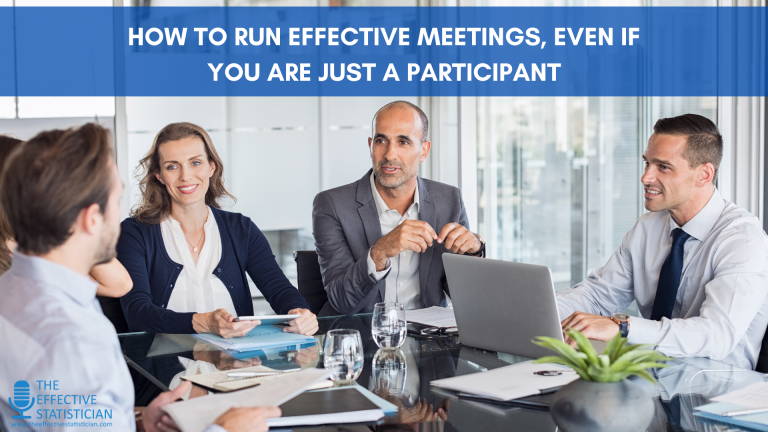

What are typical meetings you would be invited to as a statistician?
- Study meeting
- Project meetings
- Team meetings
In this episode, I talk about the important questions that we need to answer and the points we need to consider to ensure an effective meeting.
Here are the steps you can follow and what can you do if these steps are not followed in a meeting you’re invited to:
- What is the goal you want to achieve?
- Do you need a meeting at all?
- Who is really needed for the meeting?
- Who will contribute?
- Who could derail the outcome?
- Who would you need as an ally potentially?
- How long do you need the meeting to be?
- Additional tip – start 5 minutes after the hour and stop 5 minutes before the hour
- Send the meeting agenda
- Always include the goals of the meeting
- Include any pre-reads
- Any action items specifically for some of the attendees (do you need to prepare someone 1:1 beforehand)
- Start on time and end on time
- Start with the goal
- Table any topics that derail from the goal
- Ask also those that are quieter
- Organize minutes from the start (maybe display them on the screen)
- Who does what by when – clearly identify action items
- Virtual meetings – turn on the video and set this expectation beforehand
Listen to this episode now and share this with your friends and colleagues!
Never miss an episode!
Join thousends of your peers and subscribe to get our latest updates by email!
Get the


Learn on demand
Click on the button to see our Teachble Inc. cources.
Featured courses
Click on the button to see our Teachble Inc. cources.
Join The Effective Statistician LinkedIn group
This group was set up to help each other to become more effective statisticians. We’ll run challenges in this group, e.g. around writing abstracts for conferences or other projects. I’ll also post into this group further content.
I want to help the community of statisticians, data scientists, programmers and other quantitative scientists to be more influential, innovative, and effective. I believe that as a community we can help our research, our regulatory and payer systems, and ultimately physicians and patients take better decisions based on better evidence.
I work to achieve a future in which everyone can access the right evidence in the right format at the right time to make sound decisions.
When my kids are sick, I want to have good evidence to discuss with the physician about the different therapy choices.
When my mother is sick, I want her to understand the evidence and being able to understand it.
When I get sick, I want to find evidence that I can trust and that helps me to have meaningful discussions with my healthcare professionals.
I want to live in a world, where the media reports correctly about medical evidence and in which society distinguishes between fake evidence and real evidence.
Let’s work together to achieve this.

